Friday, 10 July 2015

Jewels

Another warm and cloudy night and another good haul of moths in the Robinson moth trap. There is no let up in the pace of new species for the garden appearing, with another four last night. This included a couple of good county records.

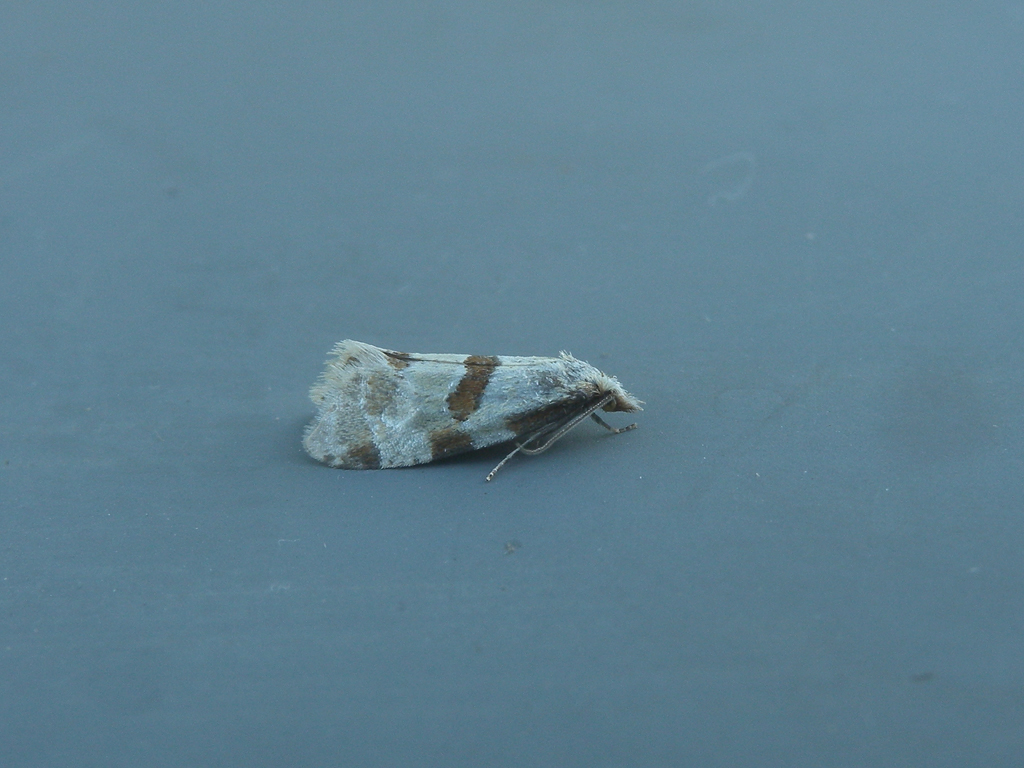
The first good moth was one that I found on the outside of a window as I was setting up the trap. This is Monopis obviella, one of the Tineidae. This species is right on the edge of its range here, in fact according to the county recorder this is only the second Shropshire record of this species. Elsewhere in its range the lack of records is partly due to confusion with the very similar Monopis crocicapitella. However, the latter species has not occurred in Shropshire, so this appears to be genuinely rare (or, as more likely, genuinely under recorded). This pretty little micromoth is separated by the dark forewing with limited white spotting, and the deep yellow colour of the band spreading back from the top of the head and along the inside edges of the forewing.

Monopis obviella

My other two new micromoths last night were pretty dull in comparison to the M. obviella. These were Brachmia blandella, a Gelechid associated with Gorse Ulex europaeus, and this positively dingy Matilella fusca (or known as Pyla fusca - I am not sure which is most current in usage). Matilella fusca uses Heather (Erica) and Bilberry (Vaccinium) as larval foodplants. The main commen theme linking my recent new micros has been an association with these and other typical upland heath plants.

Matilella fusca

On to the macromoths, and I recorded this glorious noctuid in my garden for the first time. Beautiful Brocade Lacanobia contigua is a species of moorland, heathland and woodland. I would expect this to be a species I would record here fairly frequently, so perhaps more records will follow.

Beautiful Brocade Lacanobia contigua

There were also a couple of jewels in the trap, emeralds to be precise. This splendid Large Emerald Geometra papilionaria is only my second record of what it usually a common species. I recorded this on my very first moth trapping session back in August 2012, so this is a welcome return. Another species of woods, heaths and moors, it is associated with Birch (Betula). All of these are in good supply here, and so it is a bit of mystery why I do not see this more frequently.

Large Emerald Geometra papilionaria

I have been recording Grass Emerald Pseudoterpna pruinata reasonably frequently this year, but they all appear to be very worn by the time they make it to my garden. This is probably the smartest one I have seen in the garden so far, though it still looks a little worse for wear.

Grass Emerald Pseudoterpna pruinata

One of the more interesting moths in the trap was this variant of Mottled Beauty Alcis repandata, with the broad dark brown band across the wings helping this to blend in with the garden furniture. Having not recorded this species in the garden before this year, I am now seeing them on most occasions I put out the trap. Either a good year for this species, or one that my old actinic heath trap failed to pull in.

Mottled Beauty Alcis repandata

Finally, one of the headaches for moth trappers in the summer is the identification of The Uncertain Hoplodrina octogenaria and The Rustic H. blanda. This is fiendishly difficult species pair that I have only just started to get to grips with this year. Identification is based on subtle characters to do with cross lines, ground colour and texture of the wings. This individual from last night I believe is The Rustic, but this conundrum is something I will continue to work on in the next few weeks.

The Rustic Hoplodrina blanda

Tuesday, 7 July 2015

Kite Robber

The outside walls of the house have come up trumps again, with my third Robberfly (Asilidae) of the summer. This one was on the front of the house, and I managed to snaffle it in a pot and have a closer look.

Kite-tailed Robberfly Machimus atricapillus

I believe that this is a female Kite-tailed Robberfly Machimus atricapillus. There are two very similar Machimus species with previous local records, but this one has a more strongly-marked and greyer abdomen, without the dark rings on the fore and mid tibia shown by M. cingulatus. As with others in the group, this species is predatory on many other species and flies and other insects. It is found in scrubby grassland and woodland edge habitats.

Fortunately this individual posed nicely on the side of the pot on release, allowing me to take some decent photographs.

Kite-tailed Robberfly Machimus atricapillus

Kite-tailed Robberfly Machimus atricapillus

Saturday, 4 July 2015

On the Rocks

My parents are up to visit this weekend, so we were looking for somewhere to take them. My mother has a love of wild flowers, and my father beautiful and dramatic places, so we thought we would try Llanymynech Rocks, a Shropshire Wildlife Trust reserve on the English/Welsh border. This is part of a carboniferous limestone outcrop, and so has a range of really interesting species that are difficult to see elsewhere in the county.

Whilst my mother was concentrating on the plants, I was having a look at other taxa. One of the first things I saw when leaving the car park was this magnificent fungi, growing in large, overlapping clusters. I believe this is Dryad's Saddle Polyporus squamosus. A dryad is a mythical wood nymph, and presumably the legend goes that they would rest on these brackets. They certainly seem large enough.

Dryad's Saddle Polyporus squamosus

I also got the chance to test my hoverfly identification skills, and put into practice what I learnt on the hoverfly course a few days ago. A quick check through the keys identified this species as Leucozona glaucia. This is a relatively common species that visits white umbels, and the larvae feed on ground layer aphids. This is a typical species of woodland clearings.

Leucozona glaucia

I am growing my interest in Diptera, and whilst there is a huge amount to learn I am having a stab at flies that look reasonably distinctive. I found one of these picture-winged flies on the same plant as the hoverfly above, but despite the distinctive wing pattern I had been struggling to identify it. I then happened to look at Pete Boardman's excellent invertebratechallenge365 blog, in which he describes a recent visit to Llanymynech Rocks on which he found Urophora jaceana. This is the same species as the one I found, and is associated with knapweed (Centaurea).

Urophora centaurea

There were quite a few moths around the site, and a bit of sweep netting revealed several micromoths, including a species that I had not seen before. In the warm sunshine I did not manage to get a nicely posed picture, so an in-the-pot picture will have to suffice. This is Homoeosoma sinuella, a species often found on limestone grasslands, and previously recorded at Llanymynech.

Homoeosoma sinuella

At the ohter end of the size scale I found this Narrow-bordered Five-spot Burnet Zygeana lonicerae. This was my first of the year and another species that favours alkaline grasslands. It even was happy to pose on my finger for some photographs.

Narrow-bordered Five-spot Burnet Zygeana lonicerae

Arriving home this afternoon, I noticed a soldier fly (Stratiomyidae) on the kitchen wall. I potted this up and had a look to see if I could put a name to it. Under a handlens, though difficult to see in the below picture, it can be seen there are six spines on the back edge of the scutellum. This narrows it down to one of the six Beris species. From there, the pale yellow legs, black abdomen and yellow base to the wings identifies this as Beris morrisii, a new species for me.

Beris morrisii

Friday, 3 July 2015

Hello Tiger!

There was a tiger in the moth trap yesterday. This was not a Garden Tiger moth (though there was one the other day) or even a Scarlet Tiger moth (which I have seen recently in the garden), but a Tiger Cranefly Nephrotoma flavescens. This is one of the attractively marked Nephrotoma craneflys, with the orange/yellow colouration and black markings on the abdomen and thorax. Craneflies are not exactly everyone's favourite insect, but perhaps this group of species can change some minds.

Tiger Cranefly Nephrotoma flavescens

Back to the moths themselves, and this Barred Straw Gandaritis pyraliata was the first of the season. This is a curious-looking moth with its strange posture, and is associated with bedstraws (Galium sp).

Barred Straw Gandaritis pyraliata

There were a couple of grey looking micromoths which got me very excited, if not anyone else. Anarsia spartiella is a species that I have only recorded on a couple of occasions, and is generally a little recorded species. This may be a grey species, but I have a soft spot for the subtle makings and wonderful labial palps. The larva spin the shoots of gorse (Ulex) and broom (Cytisus).

Anarsia spartiella

The other grey looking moth was another that looks beautiful in my eyes when you appreciate the subtle markings and the character of the species. This is a first record for the garden of Neofaculta ericetella, which lays its eggs on heather (Caluna).

Neofaculta ericetella

Wednesday, 1 July 2015

Hover craft

Today was spent on a hoverfly course in Mortimer Forest, on the Shropshire/Herefordshire border. The plan was to find hoverflies in a variety of habitats, with a session tomorrow to identifiy the species. The day was led by Nigel Jones, local diptera expert and all round entomologist.

It was a very hot day and hoverflies were in short supply. We did find several species though after much effort, and one of the more interesing species was this Eristalis intricarius. This large hoverfly is one of the furry bumblebee mimics, the only one of the Eristalis species to do this.

Eristalis intricarius

As always, there were plenty of other interesting insects to see. One of the bugs that we regularly found from sweeping the vegetation was this Grypocoris stysi. This is a widepsread bug, commonly found on nettles.

Grypocoris stysi

There was also this snail-killing fly Trypetoptera punctulata. This remarkable fly deposits its eggs near snails, and the larva emerge and eat the snail. Some members of this family have been used for biological snail control.

Trypetoptera punctulata

There was also this attractive crab spider Agelena labyrinthica. The bright green thorax is a sure means of identifying this species from others in the family of related spiders.

Agelena labyrinthica

There were several micromoths found as well. My favourite was this fresh Crambus pascuella. This is one of several Crambidae that are found in grassy habitats.

Crambus pascuella


Tuesday, 30 June 2015

More from the moth trap

One of my next door neighbours is away on holiday, so I took the opportunity to set the moth trap in the more open area of the garden last night. I usually avoid this as the light would shine right into my neighbours bedroom window. As with other recent sessions, there were plenty of new moths and some real crackers amongst them. So straight down to business.

I am a sucker for a good looking tortrix, and this Aethes cnicana was just the ticket. One of the Tortricinae, this is a species that uses thistles (Cirsium).

Aethes cnicana

There was a Barred Yellow Cidaria fulvata, a species that I have been hoping for in the garde,n but as it is only locally distributed I thought I may have to wait a while. This moth decided not to pose nicely, so an 'in-the-pot' picture will have to do.

Barred Yellow Cidaria fulvata

Another new micromoth was Phycitodes binaevella, and I was pleased to find three of these in the trap. They were also pleased to find each other, as the below picture shows. The Phycitinae is a new family for me, and this is another thistle feeder with larvae using Spear Thistle Cirsium vukgare

Phycitodes binaevella

The absolute star of the show was this cracking little moth Sophronia semicostella.  I was delighted to see this. This is one of the Gelechids, identifed through the furry palps, white costal streak and banded cilia. It is thought to use Sweet Vernal Grass Anthoxanthum odoratum, which grows plentifully in my garden and on the Long Mynd. In Shropshire this species has never been recorded away from the three locations, and on only one occasion since 1987 when 14 came to light at Prees Heath.

Sophronia semicostella

Running a close second for moth of the day was this Sallow Kitten Furcula furcula. I have never really noticed any sallow (Salix) around the garden, though there are some further up the valley, so perhaps this is a slight wanderer. In whatever case it was quite unexpected.

Sallow Kitten Furcula furcula

There was also my first Swallow-tailed Moth Ouraptery sambucaria of the year. Though this is a moth I have recorded many times before, I have not seen one so fresh and undamaged, with both of the 'swallow tails' intact.


Monday, 29 June 2015

A bad day for Shieldbugs

A Garden Spider Araneus diadematus spent most of this afternoon dealing with an unfortunate Hairy Shieldbug Dolycoris baccarum. I took occasional trips outside to catch up with its progress, and by the evening the prey was secreted away.

Garden Spider Araneus diadematus with Hairy Shieldbug Dolycoris baccarum

I also managed to clear up a mystery today. I have been regularly seeing a fawn-coloured and quite hairy beetle in the garden, and thinking that I should to have a stab at identifying it (even after recent trials with trying to get beetle identificaiton to species level), afterall, perhaps there were not too many beetles of a similar colouration. I found one today on a Wild Carrot (Daucaus carota) and in the end identification seems to be relatively straightforward as an Orchid Beetle Dascillus cervinus. This is a locally distributed species, and one I will ask the county recorder about to confirm my identifcation.

Orchid Beetle Dascillus cervinus