Sunday, 6 September 2015

Cats

The September Shropshire Invertebrate Group meeting took us to Prees Heath, the fantastic Butterfly Conservation reserve close to Whitchurch in the North of the county. Whilst we were too late in the season for the famous invertebrate attraction of the site, the Silver Studded Blue Plebejus argus, this was a site where we were bound to find plenty of late season interest.

It ended up to be a very enjoyable day. The weather was markedly better than it had been for several days, and as the sun shone the sweep nets and beating trays were deployed to good effect. I recorded several good species, including five species of ladybird, four species of bug, several moths and caterpillars and some nice diptera species.

The commonest shieldbug was the Gorse Shieldbug Piezodorus lituratus, though this individual was found on a Common Broom Cytisus scoparius, which seems to be preferred by the species. In fact, I am not sure I have ever seen seem on gorse (Ulex). This is an adult, though there were also some late stage instars to be seen.

Gorse Shieldbug Cytisus scoparius

A new species of bug for me was swept from some long grass on the site, these Myrmus miriformis. This is one of the Rhopalidae and is found in two colour forms, though I only found the green form on the site.

Myrmus miriformis

It was not just insects that were in evidence. There is also a large population of the spider Araneus quadratus. This adults of this spider appear in late August and early September, and it is often found in well scrubbed grassland habitats with plenty of gorse, which are robust enough for the webs to hold. This is an attractively patterned spider, and though colours can vary the basic pattern is always the same.

Araneus quadratus

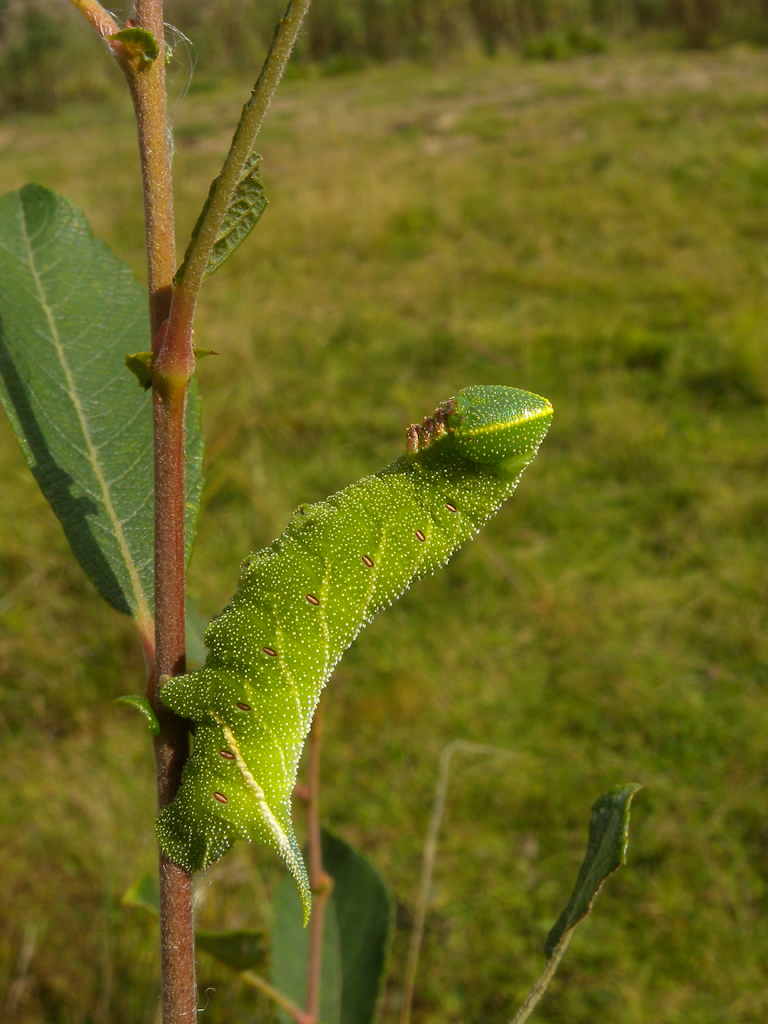
Some of the more interesting finds was a good selection of moth caterpillars, with the larva of an impressive six moth species found on the site. The crowd-pleasers were these showy Poplar Hawk-moth Laothoe populi caterpillars, found on sallow (Salix). Though they were quite obvious and easy to find, I suspect that potential predators think twice before tackling them.

Poplar Hawk-moth larva Laothoe populi

Poplar Hawk-moth Laothoe populi

This mystery caterpillar required a bit of help from county moth recorder Tony Jacques to identify. It is in fact the larva of a Burnet Companion Euclidia glyphica, and it becomes one of a small number of species that I have seen in larval bu not adult form. The larvae feed on clover (Trifolium) and trefoil (Lotus).

Burnet Companion larva Euclidia glyphica

A more expected caterpillar to find on a heathland site was the heather (Caluna) feeder Beautiful Yellow Underwing Anarta myrtilla. This is a very distinctive caterpillar, beeing a deep green with distinct white and yellow markings.

Beautiful Yellow Underwing Anarta myrtilla

We also found these young Buff-tip Phalera bucephala larvae. These caterpillars live gregariously and, as with this group, can quickly defoliate entire branches of a range of deciduous trees.

Buff-tip Phalera bucephala

This pretty pink and white caterpillar was one that I recognised, and a quick check revealed this to be the larva of the 'Ling' Pug Eupithecia absinthiata f. goossensiata. Once a distinct species, this is now thought to be the heathland race of the Wormwood Pug. The adults of the two forms look different, and the larvae look even more different.

'Ling' Pug Eupithecia absinthiata f. goossensiata

Finally, with some more identification help from Tony, I found this True Lover's Knot Lycophotia porphyrea larva. Unsurprisingly, this is another feeder on Caluna.

True Lover's Knot Lycophotia porphyrea

Saturday, 5 September 2015

Sweet like Chocolate

A decent haul of moths, with over three hundred in an around the trap. There were three new species for the garden, and several new for the year.

On the outside of the house was this Red Underwing Catocala nupta, necessitating a ladder to climb up and check it. This giant moth has been recorded twice before in my garden, both times resting on the frame of the living room window in the day.

Red Underwing Catocala nupta

Red Underwing Catocala nupta

The first new species was this first Chocolate-tip Clostera curtula for the garden. This is a species I have been hoping to catch, and I was delighted to find it resting on the sheet by the trap.


Chocolate-tip Clostera curtula

The second new species was this attractive Oak Hook-tip Watsonalla binaria. It is fair to say that this species has not really been on my radar, so it was a nice surprise to find this moth resting in the grass by the trap.

Oak Hook-tip Watsonalla binaria

The third new species was one that was definitely on my radar, the Small Square-spot Diarsia rubi. I have been looking out for this specied for some, and scratching my head to work out why I was not recording it. Was I overlooking it? Having caught a couple last night I don't think so, it just took its time to appear.

Small Square-spot Diarsia rubi

The new species for the year where the expected selection of autumn moths. These were Dusky Thorn Ennomos fuscantariaHedge Rustic Tholera cespitis and Rosy Rustic Hydraecia micacea.


Dusky Thorn Ennomos fuscantaria

Hedge Rustic Tholera cespitis

Rosy Rustic Hydraecia micacea


Thursday, 3 September 2015

Autumn harvest

It was a warm night and ideal for moth trapping, but an early start for a meeting in Bakewell meant that this was off the table. With the nights beginning to draw in, I decided to put on the porch light for an hour before I went to bed to see if anything was attracted.

This proved to be a successful approach. Amongst a couple of Flounced Rustic Luperina testacea and the first Autumnal Rustic Eugnorisma glareosa of the year, I found this attractive grey moth. I did not know what it was, which is always a cause of excitement with a macro moth. So I got out my books, and on a hunch looked up a couple of species. This enabled identification as a Grey Chi Antitype chi, the black mark on the middle of the forewing being diagnostic. This is a moth of moorland and grassy hillsides, similar habitat preferences to many species I record here. The only surprise is that it has taken me this long to find one.

Grey Chi Antitype chi

As a departure from lepidoptera, I have been seeing this attractive harvestman scurrying about on the walls of the house in recent days. When I arrived back from my drive this afternoon, I finally managed to get a photograph and an identification. This is a male Leiobunum rotundum, an attractive species with a globular orange body and black legs, often found on walls.

Leiobunum rotundum

Thursday, 27 August 2015

A Swift one

This Orange Swift Triodia sylvina was new for the year in last nights moth trap.

Orange Swift Triodia sylvina

Friday, 14 August 2015

Arches

The moth trap is seeing plenty of action at the moment, and the new species for the garden keep on coming. This morning I found tow long-desired new species, as well as a mystery to be solved.

The first of the former was this cracking male Black Arches Lymantria monacha, a beautiful species of moth. I have looked on enviosuly as others have posted pictures of this species, and was delighted to find this resting on the wall of the house. This is a woodland species, which may explain why it has taken a while for it to find its way to me.

Black Arches Lymantria monacha

The second new species was the curious Pale Prominent Pterostoma palpina. This is one of those species that you need to look at closely to work out what is going on. The long 'face' is formed by the extended labial palps and the 'tail' is formed of two tufts at the end of the abdomen.

Pale Prominent Pterostoma palpina

The mystery moth was this species of pug. I did not recognise it, but close examination revealed this to be a Golden-rod Pug Eupithecia virgaureata. This is tricky species and I would not fancy having an attempt if it was not a fresh specimen. The tuft of white scales on the top of the abdomen, subtlety of wing shape and fine detail of wing marking help to distinguish it from the similar Grey Pug E. subfuscata.

Golden-rod Pug Eupithecia virgaureata

Wednesday, 12 August 2015

A Thorny issue

Today started with a quick check of the moth trap. There was a reasonable catch, not huge numbers but a couple of nice new species for the year. The first was this Purple Thorn Selenia tetralunaria, a species of woodland and heathland. Unlike the Early Thorn S. dentaria which resolutely holds its wings close, this moth rests with its wings slightly open. There are a few other plumage features that help to distinguish the pair. The half moon like crescent markings on the underside of both the hind and forewings gives the species name tetralunaria (four moons).

Purple Thorn Selenia tetralunararia

The other new species was this Six-striped Rustic Xestia sexstrigata. It feels a little early to be catching this species, as the last post said it is a sign that autumn is coming.

Six-striped Rustic Xestua sexstrigata

When I am working from home I both manage to go through the moth trp before starting work and half a wander in the garden over lunchtime. This lunchtime I found this species of fly in the front meadow. I popped it in the spi-pot and had a closer look. This is in fact a species of hoverfly and can be easilt identified as Chrysotoxum bicinctum by the two yellow, chocolate wing patches and long forward-pointing antennae.

Chrysotoxum bicinctum

Monday, 10 August 2015

Signs of Autumn

With the most promising overnight forecast we have had for several days I decided to put out the MV Robinson moth trap on Saturday night. It was clear when I turned the trap on, but with high temperatures and predicted overcast conditions I though it was looking promising.

I was proved right in the morning. Though not quite matching the 600 moths of 'Mothageddon' a couple of weeks ago, the final totals were still impressive - 474 moths of 84 species. A quarter of the moths were Large Yellow Underwings Noctua pronuba, but otherwise there was a nice mix of moths with three new species for the garden and several new for the year. There were also not too many identification headaches, just a couple of tortrixes that I managed to pin down today.

Straight to the new species, and the first was a moth that I suspect I have overlooked in the past. This was the Buff Footman Eilema depressa, with two individuals. This was one of four species of footman recorded, with 36 Scarce Footman E. complana, 23 Common Footman E. lurideola and four Dingy Footman E. griseola.

Buff Footman Eilema depressa

The seconde new species was another that I have potentially overlooked in the past, though I am usually quite stringent on checking all of the Common Marbled Carpets Dysstroma truncata I catch. This is of course the Dark Marbled Carpet D. citrata, which can be separated by the shape of the post-median line on the underside of the hindwing amongst other subtle characters.

Dark Marbled Carpet Dysstroma citrata

Posing much less of an identification headache was this beautiful Broad-bordered Yellow Underwing Noctua fimbriata. This moth shows some sexual dimorphism, with females typically being a more orangey-buff, as with this individual, as opposed to the darker brown of the males. This species is pretty common and the larva feed on quite a range of different shrubs, though it is not a moth that I typically catch in significant numbers.

Broad-bordered Yellow Underwing Noctua fimbriana

Continuing on the yellow underwing theme, I also recorded the most diminutive of the group, this Least Yellow Underwing Noctua interjecta. This is not a common species, indeed I have only caught one individual before, so was a notable record for the garden.

Least Yellow Underwing Noctua interjecta

As the title of this blog suggests, there were some signs that autumn is just around the corner. In the late summer and into early autumn the Antler Moth Cerapteryx graminis becomes a regular feature in my moth trapping sessions. This is possibly my favourite moth, so my first record for the year has to feature on this blog. A real little stunner.

Antler Moth Cerapteryx graminis

Another notable species on Saturday night was Tawny-speckled Pug Eupithecia icterata. This is a moth I have again only recorded on one previous occasion, but there were three found resting on the garden furniture by the trap. One of the foodplants of this species is Yarrow Achillea millefolium, which I have let grow in profusion in the garden. Will this become a more regular species?

Tawny-speckled Pug Eupithecia icterata

Amongst a couple of mystery micro moths that had to be held over to today, one of them proved to be a new tortrix species Zeiraphera ratzeburgiana. This is a worn individual, which slowed down the identification process as this species shows a lot of tawny and black colouration. But detailed examination nailed it. This moth gets its name from the German entomologist J.T.C Ratzeburg.

Zeiraphera ratzeburgiana

There was also a new generation of Teleiopsis diffinis, a speciality in my garden, This species feeds on Sheep's Sorrel Rumex acetosa, which I let grow commonly in my garden and there were four of these moths in the trap.

Teleiopsis diffinis

So another good moth trapping session, and the yearlist has moved up to 275 species. I am hopeful of breaking the 300 barrier for the first time this year.