Sunday, 9 August 2015

Wollerton Wetlands

This months Shropshire Invertebrate Group meeting took place at Wollerton Wetlands. This site is to the west of Market Drayton and was created when the bypass around the village of Hodnet was built. As it was a site I was unfamiliar with I was not sure what to expect, but it ended up being a super little site with a large pool surrounding by a good variety of plants and scrub and with bountiful nectar sources.

A few species were particularly abundant. Now is the time of year to check ragwort plant for the caterpillars of the Cinnabar Moth Tyria jacobaeae. There seemed to be dozens of these juicy orange and black caterpillars clinging onto every ragwort plant around the site, with a population of a few thousand individuals. This is a great species for people starting out on entomology, as they are so attractive, distinctive, common and easy to find.

Cinnabar Moth Tyria jacobaeae

They other species that seemed to be on site in the hundreds was the Harlequin Ladybird Harmonia axyridis. This invasive species was present in every conceivable variation of markings, just one of which is shown here. The brown legs and wide keel on the elytra appear to be consistent features for this species, which can often catch people out with some of the variations looking similar to native ladybird species.

Harlequin Ladybird Harmonia axyridis

Amongst the common species, there were some that were new for me. This included the impressive four-banded longhorn beetle Leptura quadrifasciata. This is actually quite a common species, and is hopefully something I will begin to see more regularly.

Leptura quadrifasciata

As well a new beetle, I also saw a new bug. There were several species of shieldbug (Hemiptera) on one of the birch (Betula) trees, and this included several Parent Bug Elasmucha grisea. This is the final instar nymph, the streaking on the front half of the upperside is diagnostic of this species.

Parent Bug Elasmucha grisea

I was also able to pin down the identity of a tachinid fly that I have been seeing around the garden recently. I found a few of these on the site, and they proved to be Eriothrix rufomaculata, with the attractive red sides and spine on the abdomen. Whilst the adults are nectar feeders, the species is parasitic, with the larvae developing inside the larvae of moth species.

Eriothrix rufomaculata

Monday, 3 August 2015

Voyeur

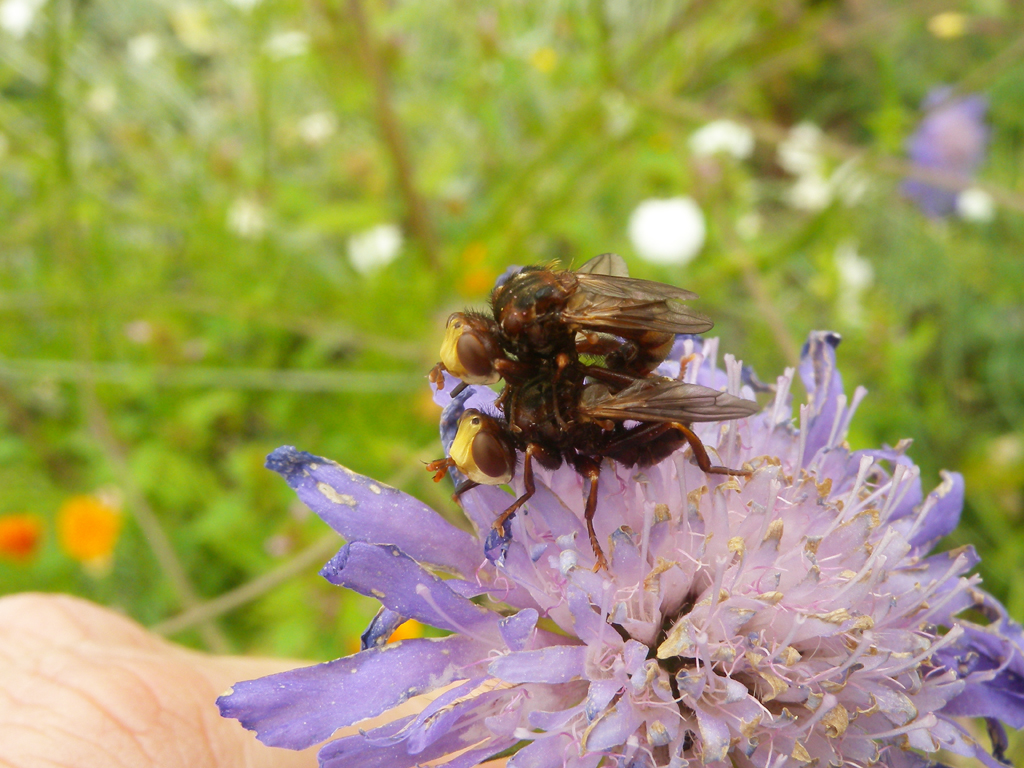
I spend a happy hour in the garden yesterday afternoon observing the mating behaviour of the Conopidae (thick-headed flies), such are the passions of a Dipterist. The species in question was Sicus ferrigineus, a fly that we have been seeing in the garden over the last couple of weeks, favouring the scabious (Scabiosa) flowers.

The pairs of flies stayed latched together throughout. I assumed that the deed had already been done, and the male was ensuring that no other male could dislodge his sperm and mate with the female. The female was nectaring on flowers (she probably needed the energy), though her flight was not quite as agile as normal with the extra baggage.

Sicus ferrugineus

This was all very nice and romantic, but things were about to get a whole lot more interesting. There was another male taking close account of the goings on and he decided that he wanted to get involved with a bit of menage-a-trois action. He latched onto the back of the male, with the triple decker causing the female to become a bit more laboured. When trying to fly to another flower the group dropped like a stone, with the interfering male shaken off. He tried a couple more times, but did not manage to dislodge male number one.

Sicus ferrugineus

Sunday, 2 August 2015

Mint Condition

The weather has improved from mid-week, mainly in that it is a bit warmer. Having only caught three moths the last time I put out the moth trap, I decided to have another go on Saturday evening. Part of the spur was this lovely little moth found by Jo in the garden. It is a Pyrausta aurata, commonly referred to as a mint moth (though the larva feed on a variety of different herbs), and it is a new record for the garden.

Pyrausta aurata

This morning there were 102 moths of 51 species, quite a nice haul. This included a few new moths for the year, including five of this lovely little micro moth Carcina quercana. As the scientific name suggests, this is a feeder on Oak (Quercus), though it will also use Beech (Fagus) and both are found in and around the garden. This is the first micromoth I identified when I started moth trapping, partly helped by the fact that it features on the front cover of my micro moth book.

Carcina quercana

Another moth that I recorded on my very first trapping session was Scalloped Oak Crocallis elinguaria, but since then I have only caught one indivudal. That changed this morning with two nice examples in and around the trap.

Scalloped Oak Crocallis elinguaria

A moth which has proven to be a bit more regular in the high summer is Catoptria pinella. This was the first appearance of the year for this beautiful little moth. It is generally not a common garden species, as it is locally distributed and likes damp grassy habitats. I seem to do quite well for it here though.

Catoptria pinella

One of the commonest micro moths in the garden, and in fact in the whole of the country, is Celypha lacunana. There were two really fresh individuals in the trap of this smart little moth,  which I thought were worth getting a photograph of. This moth has catholic tastes, and will use a wide variety of herbaceous plants, which must be one of the secrets of it's success.

Celyp[ha lacunana

Another very common moth here is the Holly Tortrix Rhopobota naevana. Whilst this moth can appear to be quite variable between individuals, the basic pattern is always the same and it's flattened body makes it very distinctive once you are familiar with it. I have also recorded the larvae of this moth in the garden, in folds of holly leaves.

Holly Tortrix Rhopobota naevana

One of the moths that I caught for the first time in my bumper 600+ catch in mid-July was Small Dotted Buff Photedes minima. Unfortunately the moth escaped before I was able to photograph it, but this morning I was given a second chance with two individuals in the trap.

Small Dotted Buff Photedes minima


Friday, 31 July 2015

A present from the in-laws

What is the most bizarre gift that have been given by your in-laws? I suspect that you have not been given a fly, particularly a large horsefly. However, this was my gift from my mother-in-law this afternoon. Jennifer had seen the fly on her patio window and rushed to get a pot, duly caught it and gave it to Jo to pass on. Whilst many people may not know quite how to take their mother-in-law presenting them with a horseefly, I was of course absolutely delighted. Especially as it is a species I have not identified before.

This is a Large Marsh Horsefly Tabanus autumnalis, a large species of biting horsefly (making it quite a specialist gift for someone). As well as the large size, this species shows three pale triangle markings on each of the abdominal segments. A quick look on the NBN shows that this would be a new record for the tetrad where Jennifers house is. If you think you can do better, Jo was once given a pot containing Japanese Knotweed for her garden from her last mother-in-law, which I suspect will take some beating.

Large Marsh Horsefly Tabanus autumnalis

Large Marsh Horsefly Tabanus autumnalis

Following the horsefly-related excitement of lunchtime, I had a more relaxed walk around the garden this evening. One of my targets was to find some wasps to look at and identify. The most familiar social wasps (the large yellow and black ones) are in fact quite an identification challenge. Whilst most people will think there is only one species of wasp in the UK, there are of course several different species. The two main families of what people would think of as a wasp are the Dolichovespula and Vespula, both of which contain four species of yellow and black wasps, which are best identified by reference to the fine details of the face pattern, with the size of the cheeks helping to seperate the two families. I managed to find a wasp settled on a Buddleia leaf, and after checking with my reference book, was happy to identify it as a Tree Wasp Dolichovespula sylvestris. The main features are the long cheeks (to place it in the Dolichovespula family), the yellow face with a small black spot and yellow base to the antennae.

Tree Wasp Dolichovespula sylvestris

Tree Wasp Dolichovespula sylvestris

Thursday, 30 July 2015

Shouting Larva, Larva, Larva

I read somewhere recently how several moth larvae feed inside the seedpods of Red Campion Silene dioica, and since then I have been looking for evidence of this on the Red Campions in the garden. I met with some success this evening, when I found this fat caterpillar whilst I was collecting Red Campion seed for my mother.

The Lychnis Hadena bicruris larva

This is the larva of The Lychnis Hadena bicruris, which is one of species that feeds inside the seedpods. This looks to be a pretty tight fit, so I expect it will not be there for too much longer.

Red Campion Silene dioica

The were two other larva in the garden today, both of which are yet to be identifed. The first was this attractive sawfly larva, which looks to be one of the Nematis species. Whilst there are plenty of photographs of similar larvae being confidently identified on the internet, I think there needs to be a bit of caution with these. So I will not take this further at this stage.

Nematis sawfly sp.

Finally, this juicy beetle larva was dug up from the soil in the garden by Jo whilst was doing some planting. I am not sure what this is, or whether it can be identifed, but I will investigate further.

Beetle larva sp.

Birch Shieldbug

I was in the Churnet Valley this morning, meeting the National Trust and Butterfly Conservation at the fantastic Hawksmoor Reserve. This is a fantastic site for woodland wildlife, and I quite liked this Birch Shieldbug Elasmostethus interstinctus sitting on a sunny Birch (Betula) leaf. This site is well worth a visit if you are in the area.

Birch Shieldbug Elasmostethus interstinctus

Monday, 27 July 2015

Office visitor

There was a vistor in the office this afternoon. I found this micromoth Mompha propinquella on the wall under my office window. It is quite a common species, and one I recorded a couple of years ago in the garden moth trap. The larvae feed on willowherb (Epilobium), several species of which grow around Batch Valley.

Mompha propinquella

I had an early start this morning, so managed to finish work a little early and had a wander around the garden to do a bit of entomologising, and there were quite a few interesting insects to be found. This Pied Hoverfly Scaeva pyrastri was perched quite contently and allowed a close appraoch. This is an amazing hoverfly, as every year this species migrates from mainland Europe to the UK. It is likely that few manage to survive the winter, so this annual influx maintains the breeding population.

Pied Hoverfly Scaeva pyrastri

The Golden Marjoram Origanum vulgare 'Aureum' is now coming into flower, and this is a fabulous plant for pollinators, one of the best in late summer in the garden. On it this afternoon was this lovely Small Copper Lycaena phlaeas, a beautiful little butterfly that is quite common in our garden. This is possibly because of the large amount of Sheep's Sorrel Rumex acetosella, the larval foodplant, which grows abundantly in our garden and on the Long Mynd.

Small Copper Lycaena phlaeas

What is certainly a new species for the garden is this small bee, which I first saw on Saturday afternoon. It has been using the cultivated knapweed (Centaurea), and was on these plants again today.

Epeolus cruciger

On closer examination in my spi-pot (an essential piece of entomological equipment made out of plastic pipe and cling-film), this appears to be Epeolus cruciger. A cleptoparasite of a couple of Colletes bee species, this is typically found on heathland and grassland, but is very scarce in Shropshire and only known from a few localities. This is a male, which is more difficult than the female to seperate from its close relative E. variegatus. The reddish pygidium, as opposed to blackish, is one of the key features.

Epeolus cruciger

There was also a bit of a mystery, with this bug nymph found on the wall of my house. I am not certain of the species, but it may be Corizus hyoscyami, a beautiful red and black bug. I will be on the lookout in the next few weeks to see if I am (hopefully) right!

Possible Corizus hyoscyami nymph