 |
| Single-dotted Wave |
Saturday, 25 August 2012
25 August
This Single-dotted Wave is roosting in our porch this morning.
I think the moth trap will be going out tonight.

Wednesday, 22 August 2012
Stag night
Since I have become interested in moths I have got into the habit of turning the porch light on for half an hour before I go to bed, to see if anything is attracted. I did this on Monday night, and it soon turned into a stag night, with this striking Antler Moth attracted to my simple moth lure.
Though a slightly bedgralled specimen, it is a beautiful insect all the same and it did not pose too much of an identification challenge. The moth is so named bacause of the white antler-shaped markings on each forewing, but the whole appearance is rather splendid. Before too long the moth was vibrating its wings to prepare for its escape.
 |
| Antler Moth |
Though a slightly bedgralled specimen, it is a beautiful insect all the same and it did not pose too much of an identification challenge. The moth is so named bacause of the white antler-shaped markings on each forewing, but the whole appearance is rather splendid. Before too long the moth was vibrating its wings to prepare for its escape.
 |
| Antler Moth |
Monday, 20 August 2012
Larva
I was working in the garden yesterday afternoon and saw this creature making it's way across the drive.
I took a few photographs and managed to find some time today to have a go at identifying it. Turned out to be quite a straightforward identification as a Buff-tip moth larva. This will overwinter in an earth chamber before the adult is flying in May, and will become a wonderful looking moth. and I started trapping a bit too late this year to catch one of these, but I will be looking out for these next year.
 |
| Buff-tip larva |
I took a few photographs and managed to find some time today to have a go at identifying it. Turned out to be quite a straightforward identification as a Buff-tip moth larva. This will overwinter in an earth chamber before the adult is flying in May, and will become a wonderful looking moth. and I started trapping a bit too late this year to catch one of these, but I will be looking out for these next year.
 |
| Buff-tip larva |
Sunday, 19 August 2012
18 August
A moth trapping session on Saturday night revealed another six new species for the garden, out of 50 moths identified. The first was this beauty found roosting on a grass stem by the trap.
Next was this noctuid, which took a little while to identify, but is actually a quite straightforward Six-striped Rustic. A subtle moth but quite distinctive.
I also had two Lesser Yellow Underwings, which were my first records. This tortix also caught my eye. It seems a tough ID between Pandemis cerasana and P. heparana, but I think this is the latter.
This very distinctive moth was roosting on the inside of the trap. It had me scratching my head for a while. Was it a very worn Swallow-tailed Moth? It didn't look right, but I could not see any other alternative with those tail projections. A bit more research and I found that it is of course a worn Light Emerald, which has lost its light green colour.
The other new moth was a Square-spot Rustic, which I found in the grass after I had put the trapping kit away. A reminder to check surrounding vegetation thoroughly.
It was noticable that numbers of footman were down, after the 58 in last weeks trap. I did get this nice comparison of Scarce and Common Footman though.
According to the Butterflies and Moths of Shropshire, Scarce Footman is a bit of a rarity in the county. This cannot be true though after the 41 last weekend and another seven today. A bit more investigation is needed to see if this is true, as the book is now quite out of date.
 |
| September Thorn |
Next was this noctuid, which took a little while to identify, but is actually a quite straightforward Six-striped Rustic. A subtle moth but quite distinctive.
 |
| Six-striped Rustic |
I also had two Lesser Yellow Underwings, which were my first records. This tortix also caught my eye. It seems a tough ID between Pandemis cerasana and P. heparana, but I think this is the latter.
 |
| Pandemis heparana |
This very distinctive moth was roosting on the inside of the trap. It had me scratching my head for a while. Was it a very worn Swallow-tailed Moth? It didn't look right, but I could not see any other alternative with those tail projections. A bit more research and I found that it is of course a worn Light Emerald, which has lost its light green colour.
 |
| Light Emerald |
The other new moth was a Square-spot Rustic, which I found in the grass after I had put the trapping kit away. A reminder to check surrounding vegetation thoroughly.
It was noticable that numbers of footman were down, after the 58 in last weeks trap. I did get this nice comparison of Scarce and Common Footman though.
 |
| Common (above) & Scarce Footman |
According to the Butterflies and Moths of Shropshire, Scarce Footman is a bit of a rarity in the county. This cannot be true though after the 41 last weekend and another seven today. A bit more investigation is needed to see if this is true, as the book is now quite out of date.
Wednesday, 15 August 2012
Moths
I ran my second trapping session at the weekend and got a bumper haul of 150+ moths, about 130 of which I managed to identify, including some really beautiful insects. Lots of new moths, with this Large Emerald a highlight roosting in a conifer by the trap. My list (in no particular order) was:
New moths for the garden included Scarce Footman, Purple Bar, a Copper Underwing type (probably a normal copper underwing), Yellow-tail and Garden Carpet. I also had this attractive micro moth Carcina quercana, which was easy to identify as it adorns the front cover of the Micro Moth book.
Continuing the them of new species, there were five White-line Darts, four Dun-bar and two Dark Arches (including this one, note the pale W). 5
There were also two Dotted Clay, a Small Phoenix, Small Fan-footed Wave, and this Phycita roborella.
The other new species were Marbled Beauty, Flounced Rustic, Common Wave and Red-barred Tortrix. A successful and enjoyable session, and I only needed help to identify ten of them!
 |
| Large Emerald |
 |
| Carcina quercana |
 |
| Dark Arches and a Scarce Footman |
 |
| Phycita roborella |
Monday, 6 August 2012
First catch
There was great excitement in Batch Valley last week as my new moth trap was delivered. I have always been interested in moth-trapping but have never had the confidence to take the plunge. However, spurred on by the moths I have seen in Batch Valley over the last few weeks I decided to give it a go. I bought the Eco20 Heath Trap from Paul Batty, which uses an actinic bulb rather than the more powerful mercury vapour. My decision was based on cost, wanting to be sensitive to my neighbours by not having an MV bulb, having a trap I can use off a car battery and having a trap which is going to not get a dauntingly huge catch.
An enjoyable and challenging session. I caught a couple of my target moths - Early Thorn and Burnished Brass, which are beautiful insects. As the list shows above, identifying moths is difficult for the inexperienced. This is particularly the case when there are worn individuals, and some when down as an either/or. There is also much variation within species, with the two July Highflyers being quite different colours.

After calling in at my local wildlife book shop to improve my library of moth ID books, a dry forecast saw the trap going out on Saturday night. It was with some excitement when I got up on Sunday morning to see what I had found. I was not disappointed with my haul of 33 moths. Not a huge number, but for an inexperienced moth-er like me this is ideal as it still took me two hours to identify them all (and I still needed some help with a couple of them)!
 |
| Early thorn |
My list of moths:
Common Footman 9
Drinker 2
Willow Beauty 1
Uncertain 2
Uncertain/Rustic 1
Magpie 1
Scalloped Oak 4
Small-dotted Wave 1
Lesser Broad-bordered Yellow Underwing 1
Early Thorn 1
Burnished Brass 1
Double Square Spot/Triple-spotted Clay 1
July Highflyer 2
Red Twin-spot Carpet 1
unidentifed 1
Catoptria pinella 1
Agriphila tristella/selasella 1
 |
| Burnished Brass |
An enjoyable and challenging session. I caught a couple of my target moths - Early Thorn and Burnished Brass, which are beautiful insects. As the list shows above, identifying moths is difficult for the inexperienced. This is particularly the case when there are worn individuals, and some when down as an either/or. There is also much variation within species, with the two July Highflyers being quite different colours.
 |
| July Highflyer |
Here's hoping for a dry night next weekend.

Tuesday, 24 July 2012
What's in a name?
We all like good-looking wildlife - weird and wonderful creatures that set the pulse racing. However, I am also a fan of weirdly-named wildlife. The creatures that when you look up their name in a book gets you wondering how on earth did they come up with that? When you get the combination of the good looking, and the fantastically named it does not get much better. I was blessed to find four such specimens on my evening walk yesterday. It started when I left the house for a walk up Batch Valley and found this lurking on my front door step.

A bit of investigation tells me that this is the drinker, a moth with a name I can sometimes relate to. But this does not gets its name from being attracted to alcoholic beverages (a light ale perhaps?), but rather the caterpillars apparent liking for drops of dew. If you don't think this is an especially interesting looking creature, then look again at the comb-like antennae. Utterly remarkable.
One thing you may be able to accuse the drinker of is being legless, which is something it has in common with the next creature I discovered.

Slow worms are simply fantastic creatures. A shimmering slither of coppery irridescence, this gorgeous lizard was uncharacteristically out in the open basking on a step. Slow worms don't just look great, they are also fascinating to boot. Being a legless lizard is interesting enough, with an ability to automotize (drop their tail to you and me) when challenged by predators is another incredible adaptation. They are also a gardeners friend for their preference for munching on slugs, which seemed to be out in abundance yesterday evening.
Feeling rather chipper about my slow worm encounter I continued up Batch Valley and soon found one of these wandering across the path.

This may look like a fairly ordinary beetle, but I think all beetles are great-looking things. This has the benefit of having the best name yet - bloody-nosed beetle. It is so-called because of its habitat of producing bright red fluid from its mouth when challenged. This is both a visual deterrant and foul-tasting, so a great predator avoidance strategy. I didn't want a demonstartion of this unusual skill, so I let the beetle go quietly about its business.
On getting back to my garden it was nice to finally see some butterflies taking advantage of the flowers, after a complete absense of them for most of the year. Amongst the meadow browns was this handsome specimen.

Of course this is a red admiral, in my opinion one of our best looking insects. A familiar creature, but why is this called after a naval officer? Well, apparently it isn't. A quick look on google tells me that the name derives from a corruption of the 18th century name of 'red admirable'. I don't know if this is true, but if so this is an insect that has been admired over centuries, and rightly so.


A bit of investigation tells me that this is the drinker, a moth with a name I can sometimes relate to. But this does not gets its name from being attracted to alcoholic beverages (a light ale perhaps?), but rather the caterpillars apparent liking for drops of dew. If you don't think this is an especially interesting looking creature, then look again at the comb-like antennae. Utterly remarkable.
One thing you may be able to accuse the drinker of is being legless, which is something it has in common with the next creature I discovered.
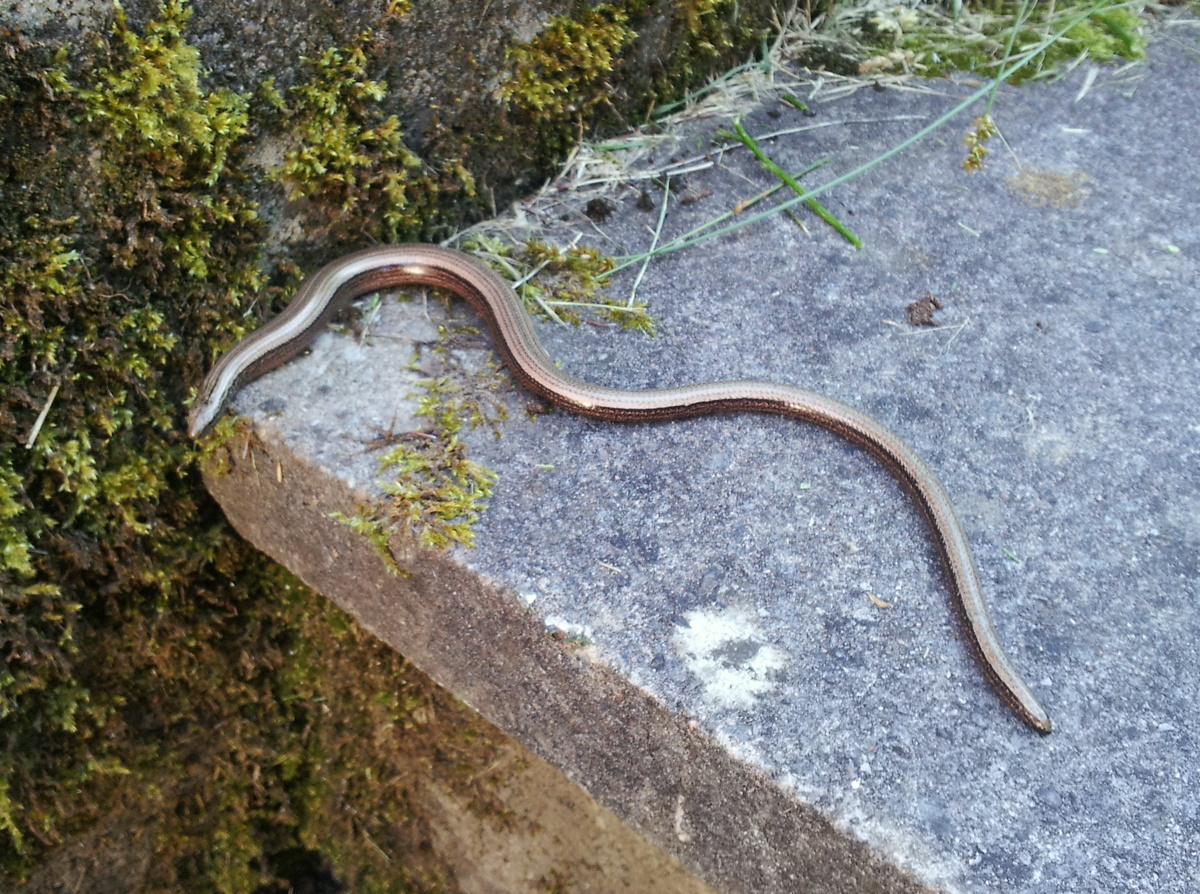
Slow worms are simply fantastic creatures. A shimmering slither of coppery irridescence, this gorgeous lizard was uncharacteristically out in the open basking on a step. Slow worms don't just look great, they are also fascinating to boot. Being a legless lizard is interesting enough, with an ability to automotize (drop their tail to you and me) when challenged by predators is another incredible adaptation. They are also a gardeners friend for their preference for munching on slugs, which seemed to be out in abundance yesterday evening.
Feeling rather chipper about my slow worm encounter I continued up Batch Valley and soon found one of these wandering across the path.

This may look like a fairly ordinary beetle, but I think all beetles are great-looking things. This has the benefit of having the best name yet - bloody-nosed beetle. It is so-called because of its habitat of producing bright red fluid from its mouth when challenged. This is both a visual deterrant and foul-tasting, so a great predator avoidance strategy. I didn't want a demonstartion of this unusual skill, so I let the beetle go quietly about its business.
On getting back to my garden it was nice to finally see some butterflies taking advantage of the flowers, after a complete absense of them for most of the year. Amongst the meadow browns was this handsome specimen.

Of course this is a red admiral, in my opinion one of our best looking insects. A familiar creature, but why is this called after a naval officer? Well, apparently it isn't. A quick look on google tells me that the name derives from a corruption of the 18th century name of 'red admirable'. I don't know if this is true, but if so this is an insect that has been admired over centuries, and rightly so.

Subscribe to:
Posts (Atom)